To my friends: I know, my blog got all formal 'n' stuff. I apologize to anyone who's disappointed, which means you, Eli Moss, the only person who reads this anymore now that I'm not in Denmark. Hi Eli!
So, what do we do at Goucher, and what don't we do?
Well, I see the school taking some steps towards environmentalism, all of which are admirable. Our dining services do a good job, and we have a very efficient heating and cooling plant. However, we miss the boat on some fairly obvious measures. I somewhat accepted reliance on paper as a fact of life in college until I went to Denmark for a semester. All my classes either encouraged or required that we hand in papers via e-mail, which were returned with comments via "track changes." No paper involved. So, why don't we all do that? Well, professors here have reasons that are understandable, but I'm not sure if they're sufficient. Most of them fall back on "I don't want to stare at a screen all day," or a lack of desire to learn a new piece of technology.
In order to get any kind of environmental initiative pushed through, it has to start with student action on a large scale. The school rarely actively opposes initiatives except on the grounds of funding, and even then they don't push back very hard or for very long if the suggestion is unambiguously the right thing to do. So, in truth, all we have to do is ask. Only a few years ago, SGA made double-sided printing standard on environmental grounds; it's just a question of how much we want it. Of course, the difference between reduced-paper and paperless is significant; nobody really opposed double-sided except for a few professors who were sticklers for proper academic format, and even then they didn't really care that much. Students and professors will oppose a paperless classroom much more.
That said, there are certain things that absolutely should be digital. The course syllabus should always be online, as should reading handouts. Even if a few people decide to print it on their own, we're still saving tons of paper. I'm using very specific examples, but the point is that in nearly all cases, the thing that we could be doing better is raising more of a fuss. The school only very occasionally makes a move on their own without student demand.
Monday, March 29, 2010

Monday, March 8, 2010
Response #6: IPCC
Unsurprisingly, the 2007 IPCC report and its summary were brought up quite frequently at Klimaforum09 in Copenhagen, giving me another opportunity to discuss my visit. (Hey everyone, did I mention that spent last semester in Copenhagen? I thought some people may not have picked up on that yet).
The report took several years to put together from hundreds of pieces of scientific and sociological literature, and by the time COP15 rolled around only two years later, some of the data was said to be out-of-date by climatologists. In fact, further research done in 2007 and 2008 pointed at climate change occurring even more rapidly and dangerously than that predicted by the IPCC. This seems to be a recurring trend. Perhaps due to fossil fuel lobbies, greed, naivete or some other factor, but we seem to think that climate change is not as big of a deal, only to find later that we should have taken action a long time ago.
On page 15 of the report summary, there is a table of how various sectors could improve in the area of environmental sustainability. In almost every category, after a series of specific suggestions, is the idea "incorporate climate change concerns into design and daily practices" or something to that effect. This points at an important goal of environmentalism. A Department of the Environment is important, and many countries have one in some form or another. However, the goal of any environmental bureau should be its own obsolescence (credit to Ailish Hopper-Meisner for teaching me that concept). A government cannot have a Department of Energy build new coal plants and a Department of the Environment create conservation areas and claim to be meeting everyone's needs. Environmental concerns will not be met as long as they are considered separate from other concerns. They must be integrated into every aspect of society. The IPCC does a good job of showing the magnitude of the problem and pointing out that it cannot be solved by disjointed efforts.
The report took several years to put together from hundreds of pieces of scientific and sociological literature, and by the time COP15 rolled around only two years later, some of the data was said to be out-of-date by climatologists. In fact, further research done in 2007 and 2008 pointed at climate change occurring even more rapidly and dangerously than that predicted by the IPCC. This seems to be a recurring trend. Perhaps due to fossil fuel lobbies, greed, naivete or some other factor, but we seem to think that climate change is not as big of a deal, only to find later that we should have taken action a long time ago.
On page 15 of the report summary, there is a table of how various sectors could improve in the area of environmental sustainability. In almost every category, after a series of specific suggestions, is the idea "incorporate climate change concerns into design and daily practices" or something to that effect. This points at an important goal of environmentalism. A Department of the Environment is important, and many countries have one in some form or another. However, the goal of any environmental bureau should be its own obsolescence (credit to Ailish Hopper-Meisner for teaching me that concept). A government cannot have a Department of Energy build new coal plants and a Department of the Environment create conservation areas and claim to be meeting everyone's needs. Environmental concerns will not be met as long as they are considered separate from other concerns. They must be integrated into every aspect of society. The IPCC does a good job of showing the magnitude of the problem and pointing out that it cannot be solved by disjointed efforts.
Monday, March 1, 2010
Response #5: Multi-faceted
In chapter 6, Speth focuses on the multitude of socioeconomic factors that go into calculating environmental impact. I appreciate his willingness to depart from the "old model" (that is, IPAT) and recognize the many other factors involved.
Matt brought up a great point in class a few weeks ago about the unfairness of using population as a factor with such prominence. Environmentalists are more or less in agreement that more people leads to a greater environmental impact, but the population factor is not of equal bearing with affluence, technology, or any of the seven other factors Speth lists. To paraphrase Matt's point, one average American child will consume more resources in his lifetime than fifty average children in the developing world. Therefore, limiting population, especially in the developing world, is a band-aid solution at best and a dishonest and unjust non-solution at worst.
The third factor, technology, I feel is also misapplied. Speth does a good job of clearing things up. It is not inherently the development of new technology that is the problem, but our unwillingness to change the definition of "progress." It has been pointed out by many environmental leaders (including many at Klimaforum09 in Copenhagen) that we have all the technology we need to solve nearly every environmental problem we are facing. We can create a sustainable electric grid worldwide, produce the things we need in a nearly waste-free way (see: Cradle to Cradle), and keep CO2 down to safe levels. Our problem is not that we need more technology. Our problem is that we have not committed to the applicaiton of technology. For example, once we have started building the number of wind turbines we really should have in the US, then we can always upgrade or switch to new methods when more efficient wind turbines become available. In the meantime, we ought to get started; the tendency is to say "the technology is not ready yet" when in fact, it has been ready for anywhere from 10-50 years, depending on which aspect of climate change we're talking about.
What does this say about us? Well, to repeat a point I've made at least three times in previous posts, we're always looking for excuses to be passive, when this is a problem that requires us to be active.
Matt brought up a great point in class a few weeks ago about the unfairness of using population as a factor with such prominence. Environmentalists are more or less in agreement that more people leads to a greater environmental impact, but the population factor is not of equal bearing with affluence, technology, or any of the seven other factors Speth lists. To paraphrase Matt's point, one average American child will consume more resources in his lifetime than fifty average children in the developing world. Therefore, limiting population, especially in the developing world, is a band-aid solution at best and a dishonest and unjust non-solution at worst.
The third factor, technology, I feel is also misapplied. Speth does a good job of clearing things up. It is not inherently the development of new technology that is the problem, but our unwillingness to change the definition of "progress." It has been pointed out by many environmental leaders (including many at Klimaforum09 in Copenhagen) that we have all the technology we need to solve nearly every environmental problem we are facing. We can create a sustainable electric grid worldwide, produce the things we need in a nearly waste-free way (see: Cradle to Cradle), and keep CO2 down to safe levels. Our problem is not that we need more technology. Our problem is that we have not committed to the applicaiton of technology. For example, once we have started building the number of wind turbines we really should have in the US, then we can always upgrade or switch to new methods when more efficient wind turbines become available. In the meantime, we ought to get started; the tendency is to say "the technology is not ready yet" when in fact, it has been ready for anywhere from 10-50 years, depending on which aspect of climate change we're talking about.
What does this say about us? Well, to repeat a point I've made at least three times in previous posts, we're always looking for excuses to be passive, when this is a problem that requires us to be active.
Friday, February 26, 2010
Response #four-and-a-half: Charismatic Megafauna
A screenshot which I think aptly illustrates the "charismatic megafauna" effect described in response #1 (click for larger version):


Monday, February 22, 2010
Response #4: More Opportunities to Bash Free Market Economics
Ah, yes. The old "free markets would solve everything if only those stupid governments would stop getting in the way" approach. How I missed thee. Dryzek chapter 6 focuses on the market, and the discourse in which the market can solve all of our problems. While Dryzek does poke holes in this discourse, as he does with all the discourses, I want to add a few that he missed.
On page 124, Dryzek notes that "owners of forests that could not be logged economically would keep them as wilderness areas or invest in wildlife conservation in order to attract hunters or photographers, who would be charged admission to provide income for these conservation investments." While Dryzek later points out that privately owned conservation land often end up being sold to developers, he missed an opportunity to make a broader point: conservation lands need to simply exist. We cannot just save forests that people want to visit, hunt in, or take photographs of. That is not truly a market solution because there are only so many hunters and photographers and only so many people taking vacations at any given time. The entire model relies on the assumption that photographers are a major economic actor. I can think of few wildlife photographers who have the kind of money required to make conservation a good investment. In the end, a forest that is not commercially viable for logging will now (most likely) eventually be commercially viable for logging, or at least for something, and whatever that thing is will probably make the owner a lot more money than conservation. Therefore, by this model, the forest will eventually be cut down. Therefore, we need a system in which forests are allowed to simply exist, regardless of whether we are actively using them for something (because we passively use them for regulating global CO2 levels, among other things).
In my high school economics class, when we were studying Adam Smith's notion of free-market capitalism, my teacher was quick to point out that even the most hardcore, bottom-line, anti-regulation capitalists admit that governments have certain responsibilities. Namely, governments must handle pieces of business that are in the best interest of everyone, but no individual has any reason to take care of. For example, ensuring drinkable water: no individual will clean a whole reservoir, but collectively everyone around needs the water to be clean. Smith lists other examples including education, the prevention of monopolies and maintaining an active military*. So, Dryzek is making a straw man argument in parts of this chapter. I'm not sure there are truly that many free-market capitalists who believe that a healthy environment will happen when every single piece of air, water, and land is owned by an individual or firm. All but the most extreme capitalists tend to back off when it comes to certain issues like drinking water. The government does have its place, and that place is to protect the people when the market does not protect them.
*I find this somewhat questionable, but he was writing in the 1770's, so I'll cut him some slack. Anyway, while I'm staunchly anti-military, I suppose if one has to exist I'd rather it be run publicly, by the government, than by a bunch of rich people each with their own private militias.
On page 124, Dryzek notes that "owners of forests that could not be logged economically would keep them as wilderness areas or invest in wildlife conservation in order to attract hunters or photographers, who would be charged admission to provide income for these conservation investments." While Dryzek later points out that privately owned conservation land often end up being sold to developers, he missed an opportunity to make a broader point: conservation lands need to simply exist. We cannot just save forests that people want to visit, hunt in, or take photographs of. That is not truly a market solution because there are only so many hunters and photographers and only so many people taking vacations at any given time. The entire model relies on the assumption that photographers are a major economic actor. I can think of few wildlife photographers who have the kind of money required to make conservation a good investment. In the end, a forest that is not commercially viable for logging will now (most likely) eventually be commercially viable for logging, or at least for something, and whatever that thing is will probably make the owner a lot more money than conservation. Therefore, by this model, the forest will eventually be cut down. Therefore, we need a system in which forests are allowed to simply exist, regardless of whether we are actively using them for something (because we passively use them for regulating global CO2 levels, among other things).
In my high school economics class, when we were studying Adam Smith's notion of free-market capitalism, my teacher was quick to point out that even the most hardcore, bottom-line, anti-regulation capitalists admit that governments have certain responsibilities. Namely, governments must handle pieces of business that are in the best interest of everyone, but no individual has any reason to take care of. For example, ensuring drinkable water: no individual will clean a whole reservoir, but collectively everyone around needs the water to be clean. Smith lists other examples including education, the prevention of monopolies and maintaining an active military*. So, Dryzek is making a straw man argument in parts of this chapter. I'm not sure there are truly that many free-market capitalists who believe that a healthy environment will happen when every single piece of air, water, and land is owned by an individual or firm. All but the most extreme capitalists tend to back off when it comes to certain issues like drinking water. The government does have its place, and that place is to protect the people when the market does not protect them.
*I find this somewhat questionable, but he was writing in the 1770's, so I'll cut him some slack. Anyway, while I'm staunchly anti-military, I suppose if one has to exist I'd rather it be run publicly, by the government, than by a bunch of rich people each with their own private militias.
Monday, February 15, 2010
Response #3: Promethians are Environmental Obstructionists
A bold title, I know.
Dryzek barely hides his own contempt for the notion that we can solve every problem by figuring out how to exploit new resources, or exploit old resources better. The Promethean argument extends as far as saying that we will eventually figure out how to harbor yesterday's pollution into today's energy source, which Dryzek compares to alchemy. There is only really one central point where I agree with Prometheans, but then feel that they take their argument in entirely the wrong direction.
I absolutely agree that there is no limit to human ingenuity. We are amazing creatures and can come up with a solution to any problem we put our minds to. However, unlikely Prometheans, I would argue that this is what we are doing right now. While the Promethean viewpoint appears to be, "we're smart, so we'll learn to live with global warming, depletion of resources, and pollution when the time comes," my viewpoint is, "we're smart, so we'll build wind farms, a smart grid, and take a sustainable approach to logging." Yes, we are incredibly resourceful as a species. That's why many of us are trying to nip this problem in the bud now, rather than wait for the economic tipping point.
At the risk of simply restating Dryzek's point, the Promethean viewpoint is unabashedly capitalist, and sees no other form of progress other than continued accumulation of things. It relies heavily on the use of misleading statistics such as global averages, which fail to account for regional differences. For example, it includes the absurd notion of "trickle-down economics," by stating that mean global increase in wealth equals increased prosperity and ability to solve new problems as they come up. In fact, what is happening is that one part of the world is accumulating wealth, and when these new challenges come up, that part of the world will be fine while the rest of the world is left by the wayside.
This time, in answering the question "what does this say about us?" I can't help but be a little sarcastic. It says that many of us in the wealthy part of the world are comfortable living the way we are living, and will come up with any excuse to protect what we feel is rightfully ours, regardless of whether or not we earned it. We are willing to cause very direct harm to people in other countries, or even the poor within our own countries, as long as it can be rationalized in terms of progress or blamed on some other factor. Critical? Yes. Harsh? Absolutely. But I can't see any other way of putting it. This is happening right now, and it's going to take a lot more pressure and education than previously thought to convince Prometheans of the error of their ways.
Dryzek barely hides his own contempt for the notion that we can solve every problem by figuring out how to exploit new resources, or exploit old resources better. The Promethean argument extends as far as saying that we will eventually figure out how to harbor yesterday's pollution into today's energy source, which Dryzek compares to alchemy. There is only really one central point where I agree with Prometheans, but then feel that they take their argument in entirely the wrong direction.
I absolutely agree that there is no limit to human ingenuity. We are amazing creatures and can come up with a solution to any problem we put our minds to. However, unlikely Prometheans, I would argue that this is what we are doing right now. While the Promethean viewpoint appears to be, "we're smart, so we'll learn to live with global warming, depletion of resources, and pollution when the time comes," my viewpoint is, "we're smart, so we'll build wind farms, a smart grid, and take a sustainable approach to logging." Yes, we are incredibly resourceful as a species. That's why many of us are trying to nip this problem in the bud now, rather than wait for the economic tipping point.
At the risk of simply restating Dryzek's point, the Promethean viewpoint is unabashedly capitalist, and sees no other form of progress other than continued accumulation of things. It relies heavily on the use of misleading statistics such as global averages, which fail to account for regional differences. For example, it includes the absurd notion of "trickle-down economics," by stating that mean global increase in wealth equals increased prosperity and ability to solve new problems as they come up. In fact, what is happening is that one part of the world is accumulating wealth, and when these new challenges come up, that part of the world will be fine while the rest of the world is left by the wayside.
This time, in answering the question "what does this say about us?" I can't help but be a little sarcastic. It says that many of us in the wealthy part of the world are comfortable living the way we are living, and will come up with any excuse to protect what we feel is rightfully ours, regardless of whether or not we earned it. We are willing to cause very direct harm to people in other countries, or even the poor within our own countries, as long as it can be rationalized in terms of progress or blamed on some other factor. Critical? Yes. Harsh? Absolutely. But I can't see any other way of putting it. This is happening right now, and it's going to take a lot more pressure and education than previously thought to convince Prometheans of the error of their ways.
Monday, February 8, 2010
Fantasy and the Art of the Mundane
Note: this is not a PSC140 post. Scroll down for my environmental blog contribution for the week of 2/8/2010
I've had a few conversations with friends recently about growing up in a world filled with wizards and magic spells. Somewhere between video games, books, movies, and role-playing, many of us spent our childhoods in the backyard with a boffing sword, holding off hordes of imaginary Chaos Warriors (yes, I went for the obscure Hero Quest reference). I've been thinking back on that a bit lately, and I've got a few thoughts about my own childhood that I want to try to iron out here. There are references in this post that not everyone will get, but I'll try to keep it accessible, such that with context clues, you can figure out what I'm getting at (if I haven't already lost everyone with Hero Quest). All references to "Avatar" are to "...: The Last Airbender," not James Cameron's recent film.
First, magic (and other magic-like things, such as elemental control in Avatar) seem to only exist as a backdrop to war. It's especially black-and-white in video games like Final Fantasy or non-video games like Dungeons and Dragons. Magic is a weapon, and nothing else. In an RPG, you would never waste your precious spell slots/points on a spell you're not planning on blasting goblins with. Maybe an occasional spell such as invisibility, so that you can sneak up on a goblin before blasting it. But that's about it.

(Gandalf with his Instant Comedy Sticks. Just add fire!)
In books, the world is typically more complex and developed, but the non-battle applications of magic are still limited. Gandalf makes fireworks for the hobbit children. Avatar Aang amuses children with spinning beads. But it's more for comic relief than any actual plot purpose. Much to my own surprise, the one counterexample I could think of was one of the most pop-culture-ish interpretations of magical worlds: Harry Potter.
The world of Harry Potter leaves room for day-to-day magic use. It's the only system I can think of where there is a spell for cleaning a room. There are magic objects that serve "mundane" purposes, like pensieves, or the Maurader's Map. Sure, they end up being plot-relevant and in the book exist only to further the fight against Evil. But it is made clear that the Maurader's Map was created for common childhood pranks, and that was it.
J.K. Rowling took steps to create a world that is "normal" except for the inclusion of magic, and I think that's noteworthy. It may be part of the reason why the books were so compelling. But at the same time, I sometimes felt like she stopped short, and created a number of spells and items that only existed for Harry and friends to find. The one I joke with friends about most often is the "patronus" (from the third book, but used again later). It appears to serve no purpose other than scaring away dementors. Which are something that the average wizard never ever encounters. Yet, it's set up as an important spell that every wizard would know. There are hundreds of these convenient set-ups in fantasy stories, and we, the readers, wouldn't have it any other way.
A second thought is that fantasy worlds tend to be completely black-and-white in terms of good and evil. Granted, other genres fall into the same trap, so we're not talking about something unique to fantasy. Still, it's worth noting that we're comfortable with our Saurons and Voldemorts and Kefkas and Firelord Ozais, and the list goes on. One of my favorite comics points out the limited nature of this setup.

(The classic D&D "alignments")
So, this all got me thinking. What if someone created a comprehensive fantasy world, with as much richness of history and detail as Lord of the Rings or Harry Potter, (or even MORE history, perhaps). Then someone took that world, and *didn't* turn it into a cataclysmic battle of good vs. evil. Would anyone read it? Would it be engaging? Could a non-epic story be told in an epic fantasy setting? If properly written, could it be deep and nuanced? The only thing that's coming to mind right now is a modern Hollywood romantic comedy set in a fantasy world, and that's actually the thing I'd *least* want to see created out of this little brainstorm.
I'm not sure what the solution is, but I know how to define the problem I'm having. Regardless of the medium, the fantasy world is a place where pretty much any action is justifiable if the enemy is "evil" (see comic linked above). And if the enemy is not human, it's even more justified. Maiming evil humans sometimes require a degree of moral turbulence, but nobody ever feels bad for an orc. Again, fantasy is not the only genre to oversimplify good and evil, but it's the one I grew up with. I see fantasy, along with a million other forms of media, as continuing the notion that the world is black-and-white. Without some other counter-balancing perspective, it becomes easy to see criminals as The Bad Guys, rather than human beings screwed by a society we create and control. It's easier to view greedy CEOs as People Who Should Die, rather than people who need a new kind of education.
I guess what I'm asking is this: in a few years, when most of the world has figured out that we've been missing the point for most of human history, and that widespread cooperation, respect and trust are truly the basis of civilization, and that there is no such thing as Good and Evil, and that we are all just People... when all those things happen, what will fantasy look like?
I've had a few conversations with friends recently about growing up in a world filled with wizards and magic spells. Somewhere between video games, books, movies, and role-playing, many of us spent our childhoods in the backyard with a boffing sword, holding off hordes of imaginary Chaos Warriors (yes, I went for the obscure Hero Quest reference). I've been thinking back on that a bit lately, and I've got a few thoughts about my own childhood that I want to try to iron out here. There are references in this post that not everyone will get, but I'll try to keep it accessible, such that with context clues, you can figure out what I'm getting at (if I haven't already lost everyone with Hero Quest). All references to "Avatar" are to "...: The Last Airbender," not James Cameron's recent film.

First, magic (and other magic-like things, such as elemental control in Avatar) seem to only exist as a backdrop to war. It's especially black-and-white in video games like Final Fantasy or non-video games like Dungeons and Dragons. Magic is a weapon, and nothing else. In an RPG, you would never waste your precious spell slots/points on a spell you're not planning on blasting goblins with. Maybe an occasional spell such as invisibility, so that you can sneak up on a goblin before blasting it. But that's about it.

(Gandalf with his Instant Comedy Sticks. Just add fire!)
In books, the world is typically more complex and developed, but the non-battle applications of magic are still limited. Gandalf makes fireworks for the hobbit children. Avatar Aang amuses children with spinning beads. But it's more for comic relief than any actual plot purpose. Much to my own surprise, the one counterexample I could think of was one of the most pop-culture-ish interpretations of magical worlds: Harry Potter.
The world of Harry Potter leaves room for day-to-day magic use. It's the only system I can think of where there is a spell for cleaning a room. There are magic objects that serve "mundane" purposes, like pensieves, or the Maurader's Map. Sure, they end up being plot-relevant and in the book exist only to further the fight against Evil. But it is made clear that the Maurader's Map was created for common childhood pranks, and that was it.
J.K. Rowling took steps to create a world that is "normal" except for the inclusion of magic, and I think that's noteworthy. It may be part of the reason why the books were so compelling. But at the same time, I sometimes felt like she stopped short, and created a number of spells and items that only existed for Harry and friends to find. The one I joke with friends about most often is the "patronus" (from the third book, but used again later). It appears to serve no purpose other than scaring away dementors. Which are something that the average wizard never ever encounters. Yet, it's set up as an important spell that every wizard would know. There are hundreds of these convenient set-ups in fantasy stories, and we, the readers, wouldn't have it any other way.
A second thought is that fantasy worlds tend to be completely black-and-white in terms of good and evil. Granted, other genres fall into the same trap, so we're not talking about something unique to fantasy. Still, it's worth noting that we're comfortable with our Saurons and Voldemorts and Kefkas and Firelord Ozais, and the list goes on. One of my favorite comics points out the limited nature of this setup.
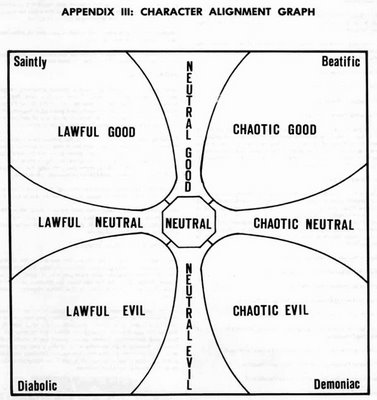
(The classic D&D "alignments")
So, this all got me thinking. What if someone created a comprehensive fantasy world, with as much richness of history and detail as Lord of the Rings or Harry Potter, (or even MORE history, perhaps). Then someone took that world, and *didn't* turn it into a cataclysmic battle of good vs. evil. Would anyone read it? Would it be engaging? Could a non-epic story be told in an epic fantasy setting? If properly written, could it be deep and nuanced? The only thing that's coming to mind right now is a modern Hollywood romantic comedy set in a fantasy world, and that's actually the thing I'd *least* want to see created out of this little brainstorm.
I'm not sure what the solution is, but I know how to define the problem I'm having. Regardless of the medium, the fantasy world is a place where pretty much any action is justifiable if the enemy is "evil" (see comic linked above). And if the enemy is not human, it's even more justified. Maiming evil humans sometimes require a degree of moral turbulence, but nobody ever feels bad for an orc. Again, fantasy is not the only genre to oversimplify good and evil, but it's the one I grew up with. I see fantasy, along with a million other forms of media, as continuing the notion that the world is black-and-white. Without some other counter-balancing perspective, it becomes easy to see criminals as The Bad Guys, rather than human beings screwed by a society we create and control. It's easier to view greedy CEOs as People Who Should Die, rather than people who need a new kind of education.
I guess what I'm asking is this: in a few years, when most of the world has figured out that we've been missing the point for most of human history, and that widespread cooperation, respect and trust are truly the basis of civilization, and that there is no such thing as Good and Evil, and that we are all just People... when all those things happen, what will fantasy look like?
Subscribe to:
Posts (Atom)