A bold title, I know.
Dryzek barely hides his own contempt for the notion that we can solve every problem by figuring out how to exploit new resources, or exploit old resources better. The Promethean argument extends as far as saying that we will eventually figure out how to harbor yesterday's pollution into today's energy source, which Dryzek compares to alchemy. There is only really one central point where I agree with Prometheans, but then feel that they take their argument in entirely the wrong direction.
I absolutely agree that there is no limit to human ingenuity. We are amazing creatures and can come up with a solution to any problem we put our minds to. However, unlikely Prometheans, I would argue that this is what we are doing right now. While the Promethean viewpoint appears to be, "we're smart, so we'll learn to live with global warming, depletion of resources, and pollution when the time comes," my viewpoint is, "we're smart, so we'll build wind farms, a smart grid, and take a sustainable approach to logging." Yes, we are incredibly resourceful as a species. That's why many of us are trying to nip this problem in the bud now, rather than wait for the economic tipping point.
At the risk of simply restating Dryzek's point, the Promethean viewpoint is unabashedly capitalist, and sees no other form of progress other than continued accumulation of things. It relies heavily on the use of misleading statistics such as global averages, which fail to account for regional differences. For example, it includes the absurd notion of "trickle-down economics," by stating that mean global increase in wealth equals increased prosperity and ability to solve new problems as they come up. In fact, what is happening is that one part of the world is accumulating wealth, and when these new challenges come up, that part of the world will be fine while the rest of the world is left by the wayside.
This time, in answering the question "what does this say about us?" I can't help but be a little sarcastic. It says that many of us in the wealthy part of the world are comfortable living the way we are living, and will come up with any excuse to protect what we feel is rightfully ours, regardless of whether or not we earned it. We are willing to cause very direct harm to people in other countries, or even the poor within our own countries, as long as it can be rationalized in terms of progress or blamed on some other factor. Critical? Yes. Harsh? Absolutely. But I can't see any other way of putting it. This is happening right now, and it's going to take a lot more pressure and education than previously thought to convince Prometheans of the error of their ways.
Monday, February 15, 2010

Monday, February 8, 2010
Fantasy and the Art of the Mundane
Note: this is not a PSC140 post. Scroll down for my environmental blog contribution for the week of 2/8/2010
I've had a few conversations with friends recently about growing up in a world filled with wizards and magic spells. Somewhere between video games, books, movies, and role-playing, many of us spent our childhoods in the backyard with a boffing sword, holding off hordes of imaginary Chaos Warriors (yes, I went for the obscure Hero Quest reference). I've been thinking back on that a bit lately, and I've got a few thoughts about my own childhood that I want to try to iron out here. There are references in this post that not everyone will get, but I'll try to keep it accessible, such that with context clues, you can figure out what I'm getting at (if I haven't already lost everyone with Hero Quest). All references to "Avatar" are to "...: The Last Airbender," not James Cameron's recent film.
First, magic (and other magic-like things, such as elemental control in Avatar) seem to only exist as a backdrop to war. It's especially black-and-white in video games like Final Fantasy or non-video games like Dungeons and Dragons. Magic is a weapon, and nothing else. In an RPG, you would never waste your precious spell slots/points on a spell you're not planning on blasting goblins with. Maybe an occasional spell such as invisibility, so that you can sneak up on a goblin before blasting it. But that's about it.

(Gandalf with his Instant Comedy Sticks. Just add fire!)
In books, the world is typically more complex and developed, but the non-battle applications of magic are still limited. Gandalf makes fireworks for the hobbit children. Avatar Aang amuses children with spinning beads. But it's more for comic relief than any actual plot purpose. Much to my own surprise, the one counterexample I could think of was one of the most pop-culture-ish interpretations of magical worlds: Harry Potter.
The world of Harry Potter leaves room for day-to-day magic use. It's the only system I can think of where there is a spell for cleaning a room. There are magic objects that serve "mundane" purposes, like pensieves, or the Maurader's Map. Sure, they end up being plot-relevant and in the book exist only to further the fight against Evil. But it is made clear that the Maurader's Map was created for common childhood pranks, and that was it.
J.K. Rowling took steps to create a world that is "normal" except for the inclusion of magic, and I think that's noteworthy. It may be part of the reason why the books were so compelling. But at the same time, I sometimes felt like she stopped short, and created a number of spells and items that only existed for Harry and friends to find. The one I joke with friends about most often is the "patronus" (from the third book, but used again later). It appears to serve no purpose other than scaring away dementors. Which are something that the average wizard never ever encounters. Yet, it's set up as an important spell that every wizard would know. There are hundreds of these convenient set-ups in fantasy stories, and we, the readers, wouldn't have it any other way.
A second thought is that fantasy worlds tend to be completely black-and-white in terms of good and evil. Granted, other genres fall into the same trap, so we're not talking about something unique to fantasy. Still, it's worth noting that we're comfortable with our Saurons and Voldemorts and Kefkas and Firelord Ozais, and the list goes on. One of my favorite comics points out the limited nature of this setup.

(The classic D&D "alignments")
So, this all got me thinking. What if someone created a comprehensive fantasy world, with as much richness of history and detail as Lord of the Rings or Harry Potter, (or even MORE history, perhaps). Then someone took that world, and *didn't* turn it into a cataclysmic battle of good vs. evil. Would anyone read it? Would it be engaging? Could a non-epic story be told in an epic fantasy setting? If properly written, could it be deep and nuanced? The only thing that's coming to mind right now is a modern Hollywood romantic comedy set in a fantasy world, and that's actually the thing I'd *least* want to see created out of this little brainstorm.
I'm not sure what the solution is, but I know how to define the problem I'm having. Regardless of the medium, the fantasy world is a place where pretty much any action is justifiable if the enemy is "evil" (see comic linked above). And if the enemy is not human, it's even more justified. Maiming evil humans sometimes require a degree of moral turbulence, but nobody ever feels bad for an orc. Again, fantasy is not the only genre to oversimplify good and evil, but it's the one I grew up with. I see fantasy, along with a million other forms of media, as continuing the notion that the world is black-and-white. Without some other counter-balancing perspective, it becomes easy to see criminals as The Bad Guys, rather than human beings screwed by a society we create and control. It's easier to view greedy CEOs as People Who Should Die, rather than people who need a new kind of education.
I guess what I'm asking is this: in a few years, when most of the world has figured out that we've been missing the point for most of human history, and that widespread cooperation, respect and trust are truly the basis of civilization, and that there is no such thing as Good and Evil, and that we are all just People... when all those things happen, what will fantasy look like?
I've had a few conversations with friends recently about growing up in a world filled with wizards and magic spells. Somewhere between video games, books, movies, and role-playing, many of us spent our childhoods in the backyard with a boffing sword, holding off hordes of imaginary Chaos Warriors (yes, I went for the obscure Hero Quest reference). I've been thinking back on that a bit lately, and I've got a few thoughts about my own childhood that I want to try to iron out here. There are references in this post that not everyone will get, but I'll try to keep it accessible, such that with context clues, you can figure out what I'm getting at (if I haven't already lost everyone with Hero Quest). All references to "Avatar" are to "...: The Last Airbender," not James Cameron's recent film.

First, magic (and other magic-like things, such as elemental control in Avatar) seem to only exist as a backdrop to war. It's especially black-and-white in video games like Final Fantasy or non-video games like Dungeons and Dragons. Magic is a weapon, and nothing else. In an RPG, you would never waste your precious spell slots/points on a spell you're not planning on blasting goblins with. Maybe an occasional spell such as invisibility, so that you can sneak up on a goblin before blasting it. But that's about it.

(Gandalf with his Instant Comedy Sticks. Just add fire!)
In books, the world is typically more complex and developed, but the non-battle applications of magic are still limited. Gandalf makes fireworks for the hobbit children. Avatar Aang amuses children with spinning beads. But it's more for comic relief than any actual plot purpose. Much to my own surprise, the one counterexample I could think of was one of the most pop-culture-ish interpretations of magical worlds: Harry Potter.
The world of Harry Potter leaves room for day-to-day magic use. It's the only system I can think of where there is a spell for cleaning a room. There are magic objects that serve "mundane" purposes, like pensieves, or the Maurader's Map. Sure, they end up being plot-relevant and in the book exist only to further the fight against Evil. But it is made clear that the Maurader's Map was created for common childhood pranks, and that was it.
J.K. Rowling took steps to create a world that is "normal" except for the inclusion of magic, and I think that's noteworthy. It may be part of the reason why the books were so compelling. But at the same time, I sometimes felt like she stopped short, and created a number of spells and items that only existed for Harry and friends to find. The one I joke with friends about most often is the "patronus" (from the third book, but used again later). It appears to serve no purpose other than scaring away dementors. Which are something that the average wizard never ever encounters. Yet, it's set up as an important spell that every wizard would know. There are hundreds of these convenient set-ups in fantasy stories, and we, the readers, wouldn't have it any other way.
A second thought is that fantasy worlds tend to be completely black-and-white in terms of good and evil. Granted, other genres fall into the same trap, so we're not talking about something unique to fantasy. Still, it's worth noting that we're comfortable with our Saurons and Voldemorts and Kefkas and Firelord Ozais, and the list goes on. One of my favorite comics points out the limited nature of this setup.
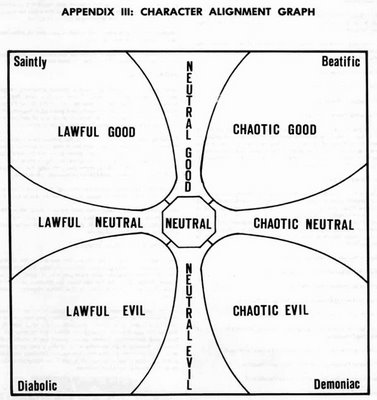
(The classic D&D "alignments")
So, this all got me thinking. What if someone created a comprehensive fantasy world, with as much richness of history and detail as Lord of the Rings or Harry Potter, (or even MORE history, perhaps). Then someone took that world, and *didn't* turn it into a cataclysmic battle of good vs. evil. Would anyone read it? Would it be engaging? Could a non-epic story be told in an epic fantasy setting? If properly written, could it be deep and nuanced? The only thing that's coming to mind right now is a modern Hollywood romantic comedy set in a fantasy world, and that's actually the thing I'd *least* want to see created out of this little brainstorm.
I'm not sure what the solution is, but I know how to define the problem I'm having. Regardless of the medium, the fantasy world is a place where pretty much any action is justifiable if the enemy is "evil" (see comic linked above). And if the enemy is not human, it's even more justified. Maiming evil humans sometimes require a degree of moral turbulence, but nobody ever feels bad for an orc. Again, fantasy is not the only genre to oversimplify good and evil, but it's the one I grew up with. I see fantasy, along with a million other forms of media, as continuing the notion that the world is black-and-white. Without some other counter-balancing perspective, it becomes easy to see criminals as The Bad Guys, rather than human beings screwed by a society we create and control. It's easier to view greedy CEOs as People Who Should Die, rather than people who need a new kind of education.
I guess what I'm asking is this: in a few years, when most of the world has figured out that we've been missing the point for most of human history, and that widespread cooperation, respect and trust are truly the basis of civilization, and that there is no such thing as Good and Evil, and that we are all just People... when all those things happen, what will fantasy look like?
Response #2: Review
Before we started reading Red Sky, it was mentioned in class that the book was a good summary of environmental issues. Unfortunately, that's all it has been for me so far. If I hadn't just spent a semester in Copenhagen learning about these issues, it would have been the perfect book for me. Unfortunately, it's ended up being more of a review so far. Hopefully later chapters will present new information. For the record, I'm not writing this to be smug about my vast, unending knowledge of environmental issues or anything so bold. Merely pointing out that this book is a summary, and is review for folks who are already involved. That said, it is incredibly well-written.
One piece of information that stuck out the most was the 450ppm C02 target. It was only three years ago that studies confirmed 350ppm as more of a "safe" target (safe in quotes, because even 350ppm will result in significant climate change). Perhaps seven years ago, during the writing of the book, 450ppm was still seen as a reasonable target. Now, further research has debunked that.
These constant readjustments seem to mirror a larger issue in our society of wishful thinking vis a vis global warming. We are constantly saying "maybe the problem will fix itself" or "maybe we'll only have to make small, incremental changes in our lifestyle." In reality, environmental issues have always required a complete overhaul of society, but we have never collectively risen to the challenge. Even if 450ppm was still considered "safe," we're on track to pass that in only another 20 years. What does this say about us? Well, first and foremost, we're comfortable living the way we are. We don't want to change, even at the expense of those who will suffer the brunt of the consequences despite their lack of contribution to the problem. Even more than that, it says that active environmentalists need to ramp up their efforts more than ever before. Helping educate people who don't know about the environmental issues, and helping mobilize people who do. That's the next step (and coincidentally, the next chapter in Speth).
One piece of information that stuck out the most was the 450ppm C02 target. It was only three years ago that studies confirmed 350ppm as more of a "safe" target (safe in quotes, because even 350ppm will result in significant climate change). Perhaps seven years ago, during the writing of the book, 450ppm was still seen as a reasonable target. Now, further research has debunked that.
These constant readjustments seem to mirror a larger issue in our society of wishful thinking vis a vis global warming. We are constantly saying "maybe the problem will fix itself" or "maybe we'll only have to make small, incremental changes in our lifestyle." In reality, environmental issues have always required a complete overhaul of society, but we have never collectively risen to the challenge. Even if 450ppm was still considered "safe," we're on track to pass that in only another 20 years. What does this say about us? Well, first and foremost, we're comfortable living the way we are. We don't want to change, even at the expense of those who will suffer the brunt of the consequences despite their lack of contribution to the problem. Even more than that, it says that active environmentalists need to ramp up their efforts more than ever before. Helping educate people who don't know about the environmental issues, and helping mobilize people who do. That's the next step (and coincidentally, the next chapter in Speth).
Monday, February 1, 2010
Response #1: Saving the Cute Animals, and other missed opportunities
"Defending species on a one-at-a-time basis has proven politically treacherous, at least beyond the defense of bald eagles, bison, and other charismatic megafauna." - Red Sky at Morning, James Gustave Speth, p. 25
More than any other, this snippet from the Speth reading caught my eye. While serious environmentalists generally have a sense of respect for all forms of life, it can be difficult to rally the public around the idea of saving a rare snail or fern. While saving the whales is important, the whales have somewhat hogged the spotlight for the past 40 years. Smaller, less iconic, less "majestic" animals get little press.
It brings me back to 2007, watching the film "Happy Feet," which does do a good job of presenting overfishing in a way that is accessible to children. But I ended the movie feeling that the point was, "Let's save the penguins because they entertain us with their wacky tap-dancing antics." The film presented this as a triumph, but for me, it more closely resembled a scene in a different animated film: the scene in The Lion King, where Zazu is being forced to sing for Scar's amusement, and if he stops he will be fed to the hyenas.
At the end of the chapter (p. 42) Speth notes that the cost of a well executed nature reserve plan would equal the amount of money spent on pet food annually by wealthy OECD countries. Pet owners are often mistaken for animal lovers, and while those two groups sometimes overlap, they certainly do not always overlap. I frequently meet pet owners who love their pets, but care little for other animals. While there are clearly much better ways of funding conservationism, I appreciated the notion that a sudden abolishment of pets could free up enough money to meet present and future forest needs.
-----
Side note: Comedian Denis Leary also has something to say about saving the cute animals (first 1:20 of the clip. Contains profanity, and quickly devolves into some disturbing imagery after about 1:30).
More than any other, this snippet from the Speth reading caught my eye. While serious environmentalists generally have a sense of respect for all forms of life, it can be difficult to rally the public around the idea of saving a rare snail or fern. While saving the whales is important, the whales have somewhat hogged the spotlight for the past 40 years. Smaller, less iconic, less "majestic" animals get little press.
It brings me back to 2007, watching the film "Happy Feet," which does do a good job of presenting overfishing in a way that is accessible to children. But I ended the movie feeling that the point was, "Let's save the penguins because they entertain us with their wacky tap-dancing antics." The film presented this as a triumph, but for me, it more closely resembled a scene in a different animated film: the scene in The Lion King, where Zazu is being forced to sing for Scar's amusement, and if he stops he will be fed to the hyenas.
At the end of the chapter (p. 42) Speth notes that the cost of a well executed nature reserve plan would equal the amount of money spent on pet food annually by wealthy OECD countries. Pet owners are often mistaken for animal lovers, and while those two groups sometimes overlap, they certainly do not always overlap. I frequently meet pet owners who love their pets, but care little for other animals. While there are clearly much better ways of funding conservationism, I appreciated the notion that a sudden abolishment of pets could free up enough money to meet present and future forest needs.
-----
Side note: Comedian Denis Leary also has something to say about saving the cute animals (first 1:20 of the clip. Contains profanity, and quickly devolves into some disturbing imagery after about 1:30).
Two Point Oh
In an unexpected turn of events, I have a school assignment to keep a blog (for my environmental studies class, no less). So, it turns out that I will be using this again after all. For my friends and family who were reading my Copenhagen postings, there's nothing stopping you from keeping this up, but expect me to make quite a few references to books and articles you haven't read.
Consider this blog rebooted!
...
*whirrrrrrrr...*
...
...
*BSOD*
Consider this blog rebooted!
...
*whirrrrrrrr...*
...
...
*BSOD*
Wednesday, December 23, 2009
Sixty Hours
I'm back in the US, and man, is it weird. Reverse culture shock all over the place. It's not that it's been a problem readjusting to American culture, so much as it's been a problem readjusting to my mom's house. She cooks for me and buys me things, which is a change from the self-made lifestyle I had in Denmark. Plus, she lives in DC, and I was wandering around today only to be asked for money by three of the fine (poor/homeless) citizens of our nation's capital and offered cheap DVDs out of the back of a car trunk by three different people. I was only out for about 45 minutes. Welcome home, Eli. To the land of "Screw you, you probably deserve to be poor." I miss social welfare already.
So, we'll see what I end up doing with this blog. I may keep updating this winter, or I may just abandon it as a testament to my trip. It is called "2009 adventures" after all, and soon it won't be 2009 anymore. But, that remains to be seen. This may be the last post, or it may not be. It'll be left up to fate, and my personal whims. You, my six readers, will be left in such great suspense, I don't know how you'll possibly handle it. Sitting there, biting your nails, holding your breath, wondering if the blog will continue. This is, after all, a piece of work that will revolutionize the very concept of literature.
But what I really want to talk about is my last two-and-a-half days in Denmark.
-----
Friday morning, I woke up late and headed to our pre-show rehearsal for the DIS closing ceremony. I've been in a singing group with other American DIS students all semester, cleverly titled DISchord (yes, it was my idea, and no, nobody else thought it was as funny as I did, but they humored me). For the final show we would be singing "Don't Stop Believing" by Journey. Because it's not a closing ceremony if it doesn't include the tackiest song ever written. Then again, maybe that's unfair; it certainly could have been worse.
So, the closing ceremony happened, we sang nicely. We were rewarded for our efforts with Christmasy tea light holders, which are a big deal in Denmark. As are candles in general. We heard a few student speakers who were pretty typical in their student speeches; "we'll all return home a newfound sense of self and trying to figure out what to do with our experiences but I'm sure we'll all be juuuuuuuuust fine, etc. etc." The president of DIS showed a slideshow of things relating to our stay, and Denmark in recent months. His one slide representing recent environmental stuff was of protesters getting arrested. He did it so that he could make a joke, but it kinda pissed me off. The reason why violent protesters are so detrimental is that the media, and subsequently the populace, latch on to these images of jerks getting arrested, so we never really learn about the cause. And he just reinforced that for the umpteenth time. But I had to let that slide to enjoy the rest of the show.
(A relatively tame example of what I'm talking about. The woman says flat-out that it was a peaceful protest with only a small pocket of violent people who were largely ignored by the rest of the protesters. And yet, a full minute of the 1:45 video is focused on them, and the title of the video implies that the whole protest went sour.)
After the ceremony, we were given free cookies. Standing around munching, I realized how few people I knew or cared about at DIS. My handful of friends left, and suddenly I had no reason to be there. I ended up chatting with a couple professors, which I always seem to find more exciting than the college kids. I'm weird like that. Besides, all the goodbyes were awkward, in part because we all knew we'd be around for another 2-3 days. We weren't really sure what to say to each other, I think.
So, I left that party and had the difficult (read: easy) choice to make between the DIS post-close party at some club downtown, and the final party for Klimaforum. The Klimaforum party included a couple guest speakers, then two different klezmer-rock bands (your guess is as good as mine). I danced a lot, and got hit on quite a bit more than I'm used to. I guess activist parties are the kind of parties where I'm considered good-looking/fashionable (beards are the new black). Or could have been my awesome dance moves. Regardless, it was a fun time.
Just as it was ending, I ran into a guy from DIS named Tim, who I only considered an acquaintance at the time, though I now consider him a friend. We had spoken a couple times about environmental stuff and living in Maryland, but we were really only at "Facebook friend" levels of knowing each other. However, after we left the party around 11:30, we started looking for a place to catch the end of the COP15 proceedings on TV, and chatted quite a bit on the way. It turns out that we have a hell of a lot in common, and the things we don't have in common are things that make us interested in hearing about each other. So, we pretty much didn't stop talking for the next three hours as we searched for a screening. We found one, but it was for journalists and NGO people only. So, we left, and just kept talking.
Saturday was spent uneventfully cleaning my room. We can just skip that part, I think. Although I do have some photos.


(Before and after cleaning my room. Cleaning even helps with hue correction!)

(Just before leaving the room for the last time)
Sunday morning I put the finishing touches on my room, kissed my key goodbye, and headed to DIS to handle some final business. I dropped off some books, recycled a huge pile of paper, and got ready to meet up with Tim. DIS housing ended on the 20th, but I was staying until the 21st, and I had a few ideas for how I was going to deal with that. However, Tim offered his air mattress, and I gladly took him up on the offer. We had a late lunch with a third friend at Riz Raz, a place downtown with an awesome vegetarian buffet. They specialize in Mediterranean food, so I had a ridiculous amount of chickpeas (in their original form, as well as in the form of hummus and falafel). I was careful about not eating out all semester so that I didn't waste money, and as a result I didn't feel too bad about having a $14 meal, especially given that it was my last lunch in Copenhagen. Good place to do it, too.

(Riz Raz, with buffet pictured on the left. It's a hell of a lot of food, and reminded me that being a vegan wouldn't really be that hard; I'd just need to learn a couple more recipes.)
We went back to his place where he immediately fell asleep. I wrote that last blog post over the next few hours while he napped. I didn't realize quite how long it was until I finished. About 2000 words, it turns out. Hope you guys enjoy my writing.
That evening, we went to Christiania to check out the last night of their Julemarked (Christmas market), but arrived to find that it was being taken down. For no logical reason, we decided to wander around the warehouse which was full of people carrying things and power tools. Not the smartest or safest move, but we ended up running into three guys in the corner playing hackeysack, which was the best thing that could have possibly happened. I hadn't played since high school except maybe once or twice, and we hacked for a good hour. Everyone was better than me by enough for me to be impressed, but they didn't have the high school "look what I can do" attitude that makes the game annoying. They didn't hog the bag, and they joked and spoke in English for our benefit. I can't think of a better way to have spent my last night in Copenhagen. We also went to one of Christiania's eateries just before it closed for the night and got some good food. It was a great time.

(What the Julemarked would have looked like, if I'd been there)
Upon returning to Tim's place, I had to blow up the air mattress manually, which was the perfect thing for making sure I passed out as soon as I was done. The thing took 20 minutes to inflate, and I've never been good at even blowing up balloons. It was satisfying, though. There's something very self-made and independent about knowing that I blew it up myself. Or maybe there's some kind of metaphor in there, with me literally sleeping on my own breath. Don't know what that means, but it at least sounds philosophical.
The next morning, Tim headed to the airport before me; there was a four-hour gap between our flights, and I didn't want to sit around for that long. So, I went to DIS and sat around there. At least I had internet. I also got my last slice of Istanbul Pizza, the local college eatery in DIS's part of town. It's that area's Antonio's, basically. Though not quite as delicious. But what is, really?
The flight was uneventful, except for running into a couple other DIS kids. I saw a few movies, listened to music, and slept. As one does on nine-hour flights. Coming back to the US, I could tell things were different right away. First of all, in Copenhagen airport and around town, there were all sorts of climate-awareness billboards and advertisements. Nothing of the sort in Chicago O'Haire or Dulles. However, two funny things did happen in Chicago worth sharing:
1) We had a 25-minute taxi from where we landed to the gate. The main theory going around was that only certain runways were cleared off after the recent snowstorm, and they were all the ones farthest away. As a result, we actually taxied across a highway. Apparently there's a highway cutting across the airport, and we literally took a plane over it (well, over a bridge over it). It was something I'd never seen before, and it cracked me up.
2) Since I've been gone, I apparently came into the possession of a chain of Chicago dessert shops. Who knew? Alas, my name did not earn me free cake, but they didn't refuse when I asked to take a picture of their stall. And I think that picture is a fitting end to my Copenhagen adventure. Partly because it has nothing to do with Copenhagen. Welcome home, me.

So, we'll see what I end up doing with this blog. I may keep updating this winter, or I may just abandon it as a testament to my trip. It is called "2009 adventures" after all, and soon it won't be 2009 anymore. But, that remains to be seen. This may be the last post, or it may not be. It'll be left up to fate, and my personal whims. You, my six readers, will be left in such great suspense, I don't know how you'll possibly handle it. Sitting there, biting your nails, holding your breath, wondering if the blog will continue. This is, after all, a piece of work that will revolutionize the very concept of literature.
But what I really want to talk about is my last two-and-a-half days in Denmark.
-----
Friday morning, I woke up late and headed to our pre-show rehearsal for the DIS closing ceremony. I've been in a singing group with other American DIS students all semester, cleverly titled DISchord (yes, it was my idea, and no, nobody else thought it was as funny as I did, but they humored me). For the final show we would be singing "Don't Stop Believing" by Journey. Because it's not a closing ceremony if it doesn't include the tackiest song ever written. Then again, maybe that's unfair; it certainly could have been worse.
So, the closing ceremony happened, we sang nicely. We were rewarded for our efforts with Christmasy tea light holders, which are a big deal in Denmark. As are candles in general. We heard a few student speakers who were pretty typical in their student speeches; "we'll all return home a newfound sense of self and trying to figure out what to do with our experiences but I'm sure we'll all be juuuuuuuuust fine, etc. etc." The president of DIS showed a slideshow of things relating to our stay, and Denmark in recent months. His one slide representing recent environmental stuff was of protesters getting arrested. He did it so that he could make a joke, but it kinda pissed me off. The reason why violent protesters are so detrimental is that the media, and subsequently the populace, latch on to these images of jerks getting arrested, so we never really learn about the cause. And he just reinforced that for the umpteenth time. But I had to let that slide to enjoy the rest of the show.
(A relatively tame example of what I'm talking about. The woman says flat-out that it was a peaceful protest with only a small pocket of violent people who were largely ignored by the rest of the protesters. And yet, a full minute of the 1:45 video is focused on them, and the title of the video implies that the whole protest went sour.)
After the ceremony, we were given free cookies. Standing around munching, I realized how few people I knew or cared about at DIS. My handful of friends left, and suddenly I had no reason to be there. I ended up chatting with a couple professors, which I always seem to find more exciting than the college kids. I'm weird like that. Besides, all the goodbyes were awkward, in part because we all knew we'd be around for another 2-3 days. We weren't really sure what to say to each other, I think.
So, I left that party and had the difficult (read: easy) choice to make between the DIS post-close party at some club downtown, and the final party for Klimaforum. The Klimaforum party included a couple guest speakers, then two different klezmer-rock bands (your guess is as good as mine). I danced a lot, and got hit on quite a bit more than I'm used to. I guess activist parties are the kind of parties where I'm considered good-looking/fashionable (beards are the new black). Or could have been my awesome dance moves. Regardless, it was a fun time.
Just as it was ending, I ran into a guy from DIS named Tim, who I only considered an acquaintance at the time, though I now consider him a friend. We had spoken a couple times about environmental stuff and living in Maryland, but we were really only at "Facebook friend" levels of knowing each other. However, after we left the party around 11:30, we started looking for a place to catch the end of the COP15 proceedings on TV, and chatted quite a bit on the way. It turns out that we have a hell of a lot in common, and the things we don't have in common are things that make us interested in hearing about each other. So, we pretty much didn't stop talking for the next three hours as we searched for a screening. We found one, but it was for journalists and NGO people only. So, we left, and just kept talking.
Saturday was spent uneventfully cleaning my room. We can just skip that part, I think. Although I do have some photos.


(Before and after cleaning my room. Cleaning even helps with hue correction!)

(Just before leaving the room for the last time)
Sunday morning I put the finishing touches on my room, kissed my key goodbye, and headed to DIS to handle some final business. I dropped off some books, recycled a huge pile of paper, and got ready to meet up with Tim. DIS housing ended on the 20th, but I was staying until the 21st, and I had a few ideas for how I was going to deal with that. However, Tim offered his air mattress, and I gladly took him up on the offer. We had a late lunch with a third friend at Riz Raz, a place downtown with an awesome vegetarian buffet. They specialize in Mediterranean food, so I had a ridiculous amount of chickpeas (in their original form, as well as in the form of hummus and falafel). I was careful about not eating out all semester so that I didn't waste money, and as a result I didn't feel too bad about having a $14 meal, especially given that it was my last lunch in Copenhagen. Good place to do it, too.

(Riz Raz, with buffet pictured on the left. It's a hell of a lot of food, and reminded me that being a vegan wouldn't really be that hard; I'd just need to learn a couple more recipes.)
We went back to his place where he immediately fell asleep. I wrote that last blog post over the next few hours while he napped. I didn't realize quite how long it was until I finished. About 2000 words, it turns out. Hope you guys enjoy my writing.
That evening, we went to Christiania to check out the last night of their Julemarked (Christmas market), but arrived to find that it was being taken down. For no logical reason, we decided to wander around the warehouse which was full of people carrying things and power tools. Not the smartest or safest move, but we ended up running into three guys in the corner playing hackeysack, which was the best thing that could have possibly happened. I hadn't played since high school except maybe once or twice, and we hacked for a good hour. Everyone was better than me by enough for me to be impressed, but they didn't have the high school "look what I can do" attitude that makes the game annoying. They didn't hog the bag, and they joked and spoke in English for our benefit. I can't think of a better way to have spent my last night in Copenhagen. We also went to one of Christiania's eateries just before it closed for the night and got some good food. It was a great time.

(What the Julemarked would have looked like, if I'd been there)
Upon returning to Tim's place, I had to blow up the air mattress manually, which was the perfect thing for making sure I passed out as soon as I was done. The thing took 20 minutes to inflate, and I've never been good at even blowing up balloons. It was satisfying, though. There's something very self-made and independent about knowing that I blew it up myself. Or maybe there's some kind of metaphor in there, with me literally sleeping on my own breath. Don't know what that means, but it at least sounds philosophical.
The next morning, Tim headed to the airport before me; there was a four-hour gap between our flights, and I didn't want to sit around for that long. So, I went to DIS and sat around there. At least I had internet. I also got my last slice of Istanbul Pizza, the local college eatery in DIS's part of town. It's that area's Antonio's, basically. Though not quite as delicious. But what is, really?
The flight was uneventful, except for running into a couple other DIS kids. I saw a few movies, listened to music, and slept. As one does on nine-hour flights. Coming back to the US, I could tell things were different right away. First of all, in Copenhagen airport and around town, there were all sorts of climate-awareness billboards and advertisements. Nothing of the sort in Chicago O'Haire or Dulles. However, two funny things did happen in Chicago worth sharing:
1) We had a 25-minute taxi from where we landed to the gate. The main theory going around was that only certain runways were cleared off after the recent snowstorm, and they were all the ones farthest away. As a result, we actually taxied across a highway. Apparently there's a highway cutting across the airport, and we literally took a plane over it (well, over a bridge over it). It was something I'd never seen before, and it cracked me up.
2) Since I've been gone, I apparently came into the possession of a chain of Chicago dessert shops. Who knew? Alas, my name did not earn me free cake, but they didn't refuse when I asked to take a picture of their stall. And I think that picture is a fitting end to my Copenhagen adventure. Partly because it has nothing to do with Copenhagen. Welcome home, me.

Sunday, December 20, 2009
Klimaforum Abridged
So, I went to a LOT of talks over the past week and a half, and I'm going to list all of them, but only discuss the highlights in detail or else this post will drag on forever. In fact, it's already pretty long, so you can always do what I did to choose which presentations to go to: look up and down this post at the topic headings, and read the details on the ones that sound interesting. Worked for me. There was a lot more info than I'm posting here, of course, so feel free to ask me about anything I went to.

(Map of the DGI-Byen, Copenhagen's massive community center and venue for Klimaforum09. All the colored rooms contained events. The largest, the orange hall, was a full basketball court plus bleachers, so it probably seated about 700 people with plenty of moving around room. The red room could hold about 100-150. I only mention this so you can get a sense of how many people were there during peak hours).
-----
"The Inner Dimensions of Climate Change." A panel of spiritual leaders discussing the connection between our thoughts and the outer world. The main points were that the more we have respect for all people and for all living things, the more we are likely to make change in our outside world. Getting rid of our own greed is part of that. It was also noted that this was a rare occasion where highly respected people of varying religions were in unanimous agreement.
"Survival Pact, not Suicide Pact." Bill McKibben, the founder of 350.org, spoke for about an hour about the success of the movement. 350.org is a campaign about spreading the word on emissions. 350 parts per million is the maximum allowable concentration of CO2 in the atmosphere if we want to live in a world that looks like it did before we industrialized (i.e. relatively cool). He credits the success of the campaign and its ability to spread worldwide to a few factors:
1) They created a 90-second video that did not require language skills to understand. Even in the poorest developing countries, someone usually has a cell phone with internet access, and word was able to spread worldwide without a language barrier.
2) They trained leaders who trained other leaders and got people mobilized through local campaigns
3) Perhaps most importantly, they had a rallying cry that rose above individual organizations. Every organization has its own focus (preserving the rainforest, reducing emissions, saving whales, funding research, etc.) but all those things somehow come back to the principles of the 350 campaign; these groups are all connected by a common environmentalist thread. So, when it came time for a global day of action, thousands of individuals and organizations did their own, decentralized actions under the 350 banner. We also got to see a lot of photos from recent 350 events.
Bill told a few personal stories about the photos, then introduced Mohammad Nasheed, the president of the Maldives. Nasheed came to speak to us before going to COP15 because in his eyes, the Klimaforum folks are the ones actually accomplishing something for the environment and for his country.
The Maldives are worth reading about. They're going to be one of the first countries to get completely screwed by global warming because the whole country is a series of low islands, and the place is disappearing underwater fast. When I say "going to be" I really mean that it's already begun. They've already lost their coral reefs, which provide some protection against natural disasters. I didn't actually know that coral reefs did that, but apparently they do. Well, they did, anyway. Not so much anymore.
"Eventually We'll All Be Middle Class." A pointless art film I wish I hadn't wasted my time seeing. The artists decided the night before that they would sign out the room to show it because nobody else was using it. Their justification for showing it there was that it's about "the world" and "saving people" but it had nothing to do with climate change, and more to do with saving the poets and artists. Even the really, really bad ones, apparently. It's only notable because it reminded me why I hated my Workshop in Experimental Theatre freshman year. It's "art for art's sake," which is an invention of the privileged. The "art of the masses," if we want to call it that, doesn't come from a sense of "this would be a fun diversion," it comes from a deep need to get something out there. If it does not feel soul-burningly necessary to make whatever it is you're making, then you're not really making art, so much as goofing off. Which is fine, I guess. Except in this sort of context, when people who could have been learning about climate change were tricked into coming by a misleading description in the Klimaforum program. But now I'm getting ranty about this. Moving on...
"Progress - A New Millenium." A film about how we need to stop defining "progress" as "the accumulation of more things. Plenty of famous people interviewed on this, including the Dalai Lama, Gorbachev, and a bunch of scientists and writers. Interesting film, and I'd recommend it to others, though it didn't tell me anything I didn't personally already know.
"Political Salon: Reflections on Gender, Climate and Change" A pure discussion, in a fishbowl format. It was opened up by a group of Latino women dressed as panthers doing a performance about climate justice. The theme of the discussion was about how the rich, and mostly rich men, benefit from fossil fuels, and the poor, mostly women in developing nations, are harmed by the effects of climate change. Excellent discussion that highlighted the multifaceted nature of the issue.
"Moving Towards Zero Carbon and Beyond." A panel of speakers, including one of the main people from zerocarbonbritain.com. Their proposal is not perfect and includes a carbon-trading scheme that most people at Klimaforum are against. But other that, they've created it's a completely feasible way for the UK to go carbon neutral in only ten years (or at least most of the way). It needs fixing, but it's the best and most detailed proposal of its kind that I've seen. Worth checking out their material. The whole proposal is on the web, as are summaries for those of you who don't have hours of free time (read: all of you)
Also presenting was a member of the Australian parliament, who was talking about the hidden challenges involved in most green proposals. For example, we absolutely need to have a plan that says "we're going to install X number of wind turbines and solar panels" but those proposals also need to say "we're going to set Y amount of money aside to train people on how to install them." The infrastructure to support a green advancement has to appear at the same time as the advancement itself. When that doesn't happen, you have 100 qualified contractors trying to do the work of 1000, and things don't get done on time, or done well. The speakers were great, and among my favorites at Klimaforum.
"Growth is Good!" A presentation of the cradle to cradle concept. Look it up.
Basically, everything we make has organic components and inorganic components, and if we could separate those out, and use the right materials, we could always bury/biodegrade the organic and reuse or reprocess the inorganic, preventing us from ever needing new raw materials ever again. The presenter explained the concept well, and it's a great concept, but the guy was also a bit of an ass, and pissed off half the audience by making jokes in poor taste and saying that the environmental movement has missed the boat, and that he, in fact, has the answers. He also used the examples of carpet squares, because a company called Desso is making 97% cradle-to-cradle carpet squares. He got called out during the question period on picking the most bourgeois example possible, and that saying we should all buy carpets from Desso doesn't really fit with the anti-consumerist vibe of Klimaforum.
My conclusion was that most of us took the good parts of his presentation (C2C) and left the bad (shameless capitalism), so no real harm done. He undermined his own point a bit, but nobody actually disagrees with cradle-to-cradle at its core. So yes, he used the pretty mainstream example ofcarpet squares (in the words of one angry activist, "nobody gives a shit about carpet squares"). But he COULD have used shoes or diapers or a few other items which will probably still be necessary after The Revolution (unlike carpet squares).
"Breakthrough Advanced Free Energy Technology." I tried to be open minded about this one, but basically, it was two conspiracy theory groups talking about how the government has a secret thing that makes electricity out of nothing, but the oil lobbies don't want it to go public. One of the groups believed that we had this technology because aliens have landed with it. I buy the underlying concept, that the government and oil lobbies have stifled progress. But... seriously? Aliens?
I'm not even ruling out the possibility that aliens exist. The truth is, I just don't care whether they exist or not. If they landed and are talking to the president, or have been flying around secretly for eons, or any of the other theories people have come up with... it doesn't change anything. Even if this guy is right, and they're here and the government is hiding technology... so what? I'm already protesting the government's refusal to go green. I'm going to keep doing that, and weaken the oil lobbies how I can, and if that eventually leads to the revelation of an environmental Magic Bullet, then yay. If it leads to incremental improvements in renewable capacity, then also yay. It really doesn't change a thing. Except, possibly, for how crazy people think I am.
"Climate Broadcasters: How to Communicate Climate Change." A presentation of ideas for how weathermen could be used to present climate issues to a large audience. Especially in places like the US where there are millions of people who still Don't Quite Get It. The panel consisted of weathermen, who liked the ideas, but would have a hard time getting more airtime.
"Are You Getting the Deal You Came For?" An excellently moderated three-hour discussion with hundreds of people to answer the important questions, including "What would a good deal look like?" and "What do we do now that the deal is clearly not going to happen this year?" Most effective group discussion I've ever seen with 600 people in a room. It wasn't perfect, and some people had to be cut off due to rambly or off-topic mic-hogging, but it worked very well, largely thanks to the guy running it. He was very focused on keeping things democratic, and we got to hear a lot of perspectives and ideas. The general consensus is that the deal needs to be stronger, and the "what we do" is "keep building the movement." It's vital that those in power hear that there is a large (and quickly growing) number of people who want the temperature to stay put where it is.
-----
The last thing I went to was the Klimaforum closing ceremony/party, but I'll wait until my "What I did the last couple days in Copenhagen" post to talk about that. Kickin' party. Klimaforum was a great time, and I learned a lot. I'm ready to go home and be much more involved in the various organizations in and around Baltimore. I'm not typically one to care about arbitrary calendar designations, but I'm specifically excited about 2010 for some reason. Should be good. And now, it's time to get some sleep, as I fly back to the US tomorrow afternoon. Yay for home.

(Map of the DGI-Byen, Copenhagen's massive community center and venue for Klimaforum09. All the colored rooms contained events. The largest, the orange hall, was a full basketball court plus bleachers, so it probably seated about 700 people with plenty of moving around room. The red room could hold about 100-150. I only mention this so you can get a sense of how many people were there during peak hours).
-----
"The Inner Dimensions of Climate Change." A panel of spiritual leaders discussing the connection between our thoughts and the outer world. The main points were that the more we have respect for all people and for all living things, the more we are likely to make change in our outside world. Getting rid of our own greed is part of that. It was also noted that this was a rare occasion where highly respected people of varying religions were in unanimous agreement.
"Survival Pact, not Suicide Pact." Bill McKibben, the founder of 350.org, spoke for about an hour about the success of the movement. 350.org is a campaign about spreading the word on emissions. 350 parts per million is the maximum allowable concentration of CO2 in the atmosphere if we want to live in a world that looks like it did before we industrialized (i.e. relatively cool). He credits the success of the campaign and its ability to spread worldwide to a few factors:
1) They created a 90-second video that did not require language skills to understand. Even in the poorest developing countries, someone usually has a cell phone with internet access, and word was able to spread worldwide without a language barrier.
2) They trained leaders who trained other leaders and got people mobilized through local campaigns
3) Perhaps most importantly, they had a rallying cry that rose above individual organizations. Every organization has its own focus (preserving the rainforest, reducing emissions, saving whales, funding research, etc.) but all those things somehow come back to the principles of the 350 campaign; these groups are all connected by a common environmentalist thread. So, when it came time for a global day of action, thousands of individuals and organizations did their own, decentralized actions under the 350 banner. We also got to see a lot of photos from recent 350 events.
Bill told a few personal stories about the photos, then introduced Mohammad Nasheed, the president of the Maldives. Nasheed came to speak to us before going to COP15 because in his eyes, the Klimaforum folks are the ones actually accomplishing something for the environment and for his country.
The Maldives are worth reading about. They're going to be one of the first countries to get completely screwed by global warming because the whole country is a series of low islands, and the place is disappearing underwater fast. When I say "going to be" I really mean that it's already begun. They've already lost their coral reefs, which provide some protection against natural disasters. I didn't actually know that coral reefs did that, but apparently they do. Well, they did, anyway. Not so much anymore.
"Eventually We'll All Be Middle Class." A pointless art film I wish I hadn't wasted my time seeing. The artists decided the night before that they would sign out the room to show it because nobody else was using it. Their justification for showing it there was that it's about "the world" and "saving people" but it had nothing to do with climate change, and more to do with saving the poets and artists. Even the really, really bad ones, apparently. It's only notable because it reminded me why I hated my Workshop in Experimental Theatre freshman year. It's "art for art's sake," which is an invention of the privileged. The "art of the masses," if we want to call it that, doesn't come from a sense of "this would be a fun diversion," it comes from a deep need to get something out there. If it does not feel soul-burningly necessary to make whatever it is you're making, then you're not really making art, so much as goofing off. Which is fine, I guess. Except in this sort of context, when people who could have been learning about climate change were tricked into coming by a misleading description in the Klimaforum program. But now I'm getting ranty about this. Moving on...
"Progress - A New Millenium." A film about how we need to stop defining "progress" as "the accumulation of more things. Plenty of famous people interviewed on this, including the Dalai Lama, Gorbachev, and a bunch of scientists and writers. Interesting film, and I'd recommend it to others, though it didn't tell me anything I didn't personally already know.
"Political Salon: Reflections on Gender, Climate and Change" A pure discussion, in a fishbowl format. It was opened up by a group of Latino women dressed as panthers doing a performance about climate justice. The theme of the discussion was about how the rich, and mostly rich men, benefit from fossil fuels, and the poor, mostly women in developing nations, are harmed by the effects of climate change. Excellent discussion that highlighted the multifaceted nature of the issue.
"Moving Towards Zero Carbon and Beyond." A panel of speakers, including one of the main people from zerocarbonbritain.com. Their proposal is not perfect and includes a carbon-trading scheme that most people at Klimaforum are against. But other that, they've created it's a completely feasible way for the UK to go carbon neutral in only ten years (or at least most of the way). It needs fixing, but it's the best and most detailed proposal of its kind that I've seen. Worth checking out their material. The whole proposal is on the web, as are summaries for those of you who don't have hours of free time (read: all of you)
Also presenting was a member of the Australian parliament, who was talking about the hidden challenges involved in most green proposals. For example, we absolutely need to have a plan that says "we're going to install X number of wind turbines and solar panels" but those proposals also need to say "we're going to set Y amount of money aside to train people on how to install them." The infrastructure to support a green advancement has to appear at the same time as the advancement itself. When that doesn't happen, you have 100 qualified contractors trying to do the work of 1000, and things don't get done on time, or done well. The speakers were great, and among my favorites at Klimaforum.
"Growth is Good!" A presentation of the cradle to cradle concept. Look it up.
Basically, everything we make has organic components and inorganic components, and if we could separate those out, and use the right materials, we could always bury/biodegrade the organic and reuse or reprocess the inorganic, preventing us from ever needing new raw materials ever again. The presenter explained the concept well, and it's a great concept, but the guy was also a bit of an ass, and pissed off half the audience by making jokes in poor taste and saying that the environmental movement has missed the boat, and that he, in fact, has the answers. He also used the examples of carpet squares, because a company called Desso is making 97% cradle-to-cradle carpet squares. He got called out during the question period on picking the most bourgeois example possible, and that saying we should all buy carpets from Desso doesn't really fit with the anti-consumerist vibe of Klimaforum.
My conclusion was that most of us took the good parts of his presentation (C2C) and left the bad (shameless capitalism), so no real harm done. He undermined his own point a bit, but nobody actually disagrees with cradle-to-cradle at its core. So yes, he used the pretty mainstream example ofcarpet squares (in the words of one angry activist, "nobody gives a shit about carpet squares"). But he COULD have used shoes or diapers or a few other items which will probably still be necessary after The Revolution (unlike carpet squares).
"Breakthrough Advanced Free Energy Technology." I tried to be open minded about this one, but basically, it was two conspiracy theory groups talking about how the government has a secret thing that makes electricity out of nothing, but the oil lobbies don't want it to go public. One of the groups believed that we had this technology because aliens have landed with it. I buy the underlying concept, that the government and oil lobbies have stifled progress. But... seriously? Aliens?
I'm not even ruling out the possibility that aliens exist. The truth is, I just don't care whether they exist or not. If they landed and are talking to the president, or have been flying around secretly for eons, or any of the other theories people have come up with... it doesn't change anything. Even if this guy is right, and they're here and the government is hiding technology... so what? I'm already protesting the government's refusal to go green. I'm going to keep doing that, and weaken the oil lobbies how I can, and if that eventually leads to the revelation of an environmental Magic Bullet, then yay. If it leads to incremental improvements in renewable capacity, then also yay. It really doesn't change a thing. Except, possibly, for how crazy people think I am.
"Climate Broadcasters: How to Communicate Climate Change." A presentation of ideas for how weathermen could be used to present climate issues to a large audience. Especially in places like the US where there are millions of people who still Don't Quite Get It. The panel consisted of weathermen, who liked the ideas, but would have a hard time getting more airtime.
"Are You Getting the Deal You Came For?" An excellently moderated three-hour discussion with hundreds of people to answer the important questions, including "What would a good deal look like?" and "What do we do now that the deal is clearly not going to happen this year?" Most effective group discussion I've ever seen with 600 people in a room. It wasn't perfect, and some people had to be cut off due to rambly or off-topic mic-hogging, but it worked very well, largely thanks to the guy running it. He was very focused on keeping things democratic, and we got to hear a lot of perspectives and ideas. The general consensus is that the deal needs to be stronger, and the "what we do" is "keep building the movement." It's vital that those in power hear that there is a large (and quickly growing) number of people who want the temperature to stay put where it is.
-----
The last thing I went to was the Klimaforum closing ceremony/party, but I'll wait until my "What I did the last couple days in Copenhagen" post to talk about that. Kickin' party. Klimaforum was a great time, and I learned a lot. I'm ready to go home and be much more involved in the various organizations in and around Baltimore. I'm not typically one to care about arbitrary calendar designations, but I'm specifically excited about 2010 for some reason. Should be good. And now, it's time to get some sleep, as I fly back to the US tomorrow afternoon. Yay for home.
Subscribe to:
Posts (Atom)